The Embedded Fintech Stack, Mapped: Money In, Money Out, and the Ledger Underneath

A guide to the financial capabilities SaaS platforms embed, including the accounting layer that records and reconciles it all
Many SaaS platforms serving small businesses now build at least one financial capability into their products, with some offering several at once. Embedded offerings like payments, capital, payroll, bill pay, banking, and accounting each solve a real problem for the SMBs using the platform—but they don’t all do the same kind of work. The clearest way to tell them apart is to map out which way the money moves.
This guide takes a close look at each capability, including what it does, where it shows up in the books, how it connects to other features, and when to build it. It’s the practical companion to our look at the shift from point solutions to a unified financial OS.
The Embedded Fintech Stack at a Glance
Most embedded fintech stacks for SMB SaaS platforms are built from six capabilities. Each is defined by the way it moves money, what it sends to the books, and where it connects to the rest of the stack.
How Money Moves Through the Stack
The direction money moves determines how each flow shows up in the books and where it runs into the other capabilities.
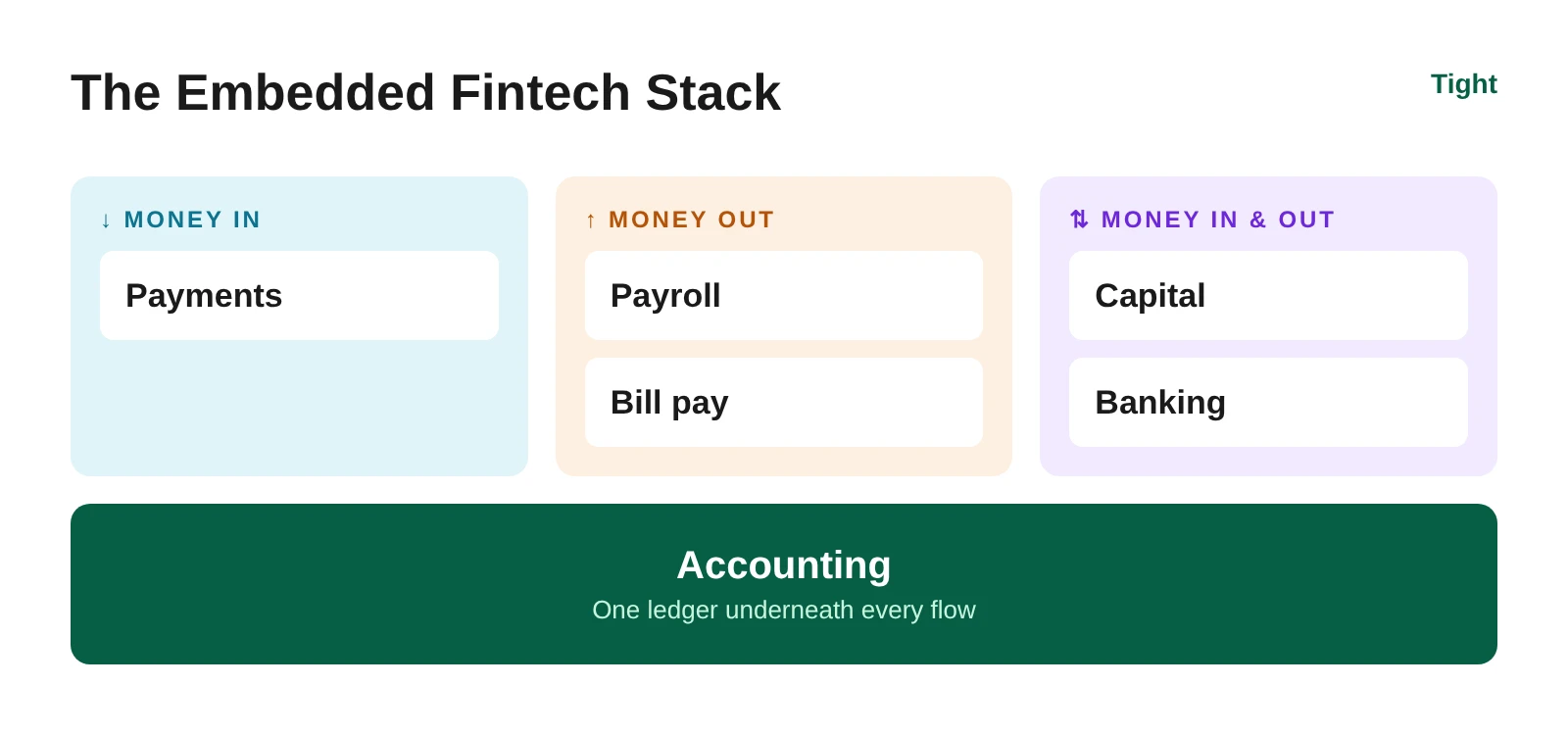
Money In
Payments
Payments let a platform’s customers accept card, ACH, and other payments without leaving the product. For many platforms, they sit right on top of the core workflow: the invoice, booking, or order the software already manages is what the customer pays. That makes payments the stack’s main source of transaction data. Each sale carries who paid, for what, when, and what it cost to process, and the rest of the stack depends on those details.
Most of what comes in is revenue, but not all of it. It also includes things like refunds, which reverse revenue, and processing fees that reduce what lands in the bank account—so the books have to separate what the business earned from what it received.
Payouts typically arrive in batches, net of fees, a day or more after their respective sales. That means the books have to tie each deposit back to the individual transactions they cover, recording the full sale as revenue and the fees as an expense. Without that link, the business sees deposits that don’t match any single sale, and someone has to work backward to figure out what each one contains.
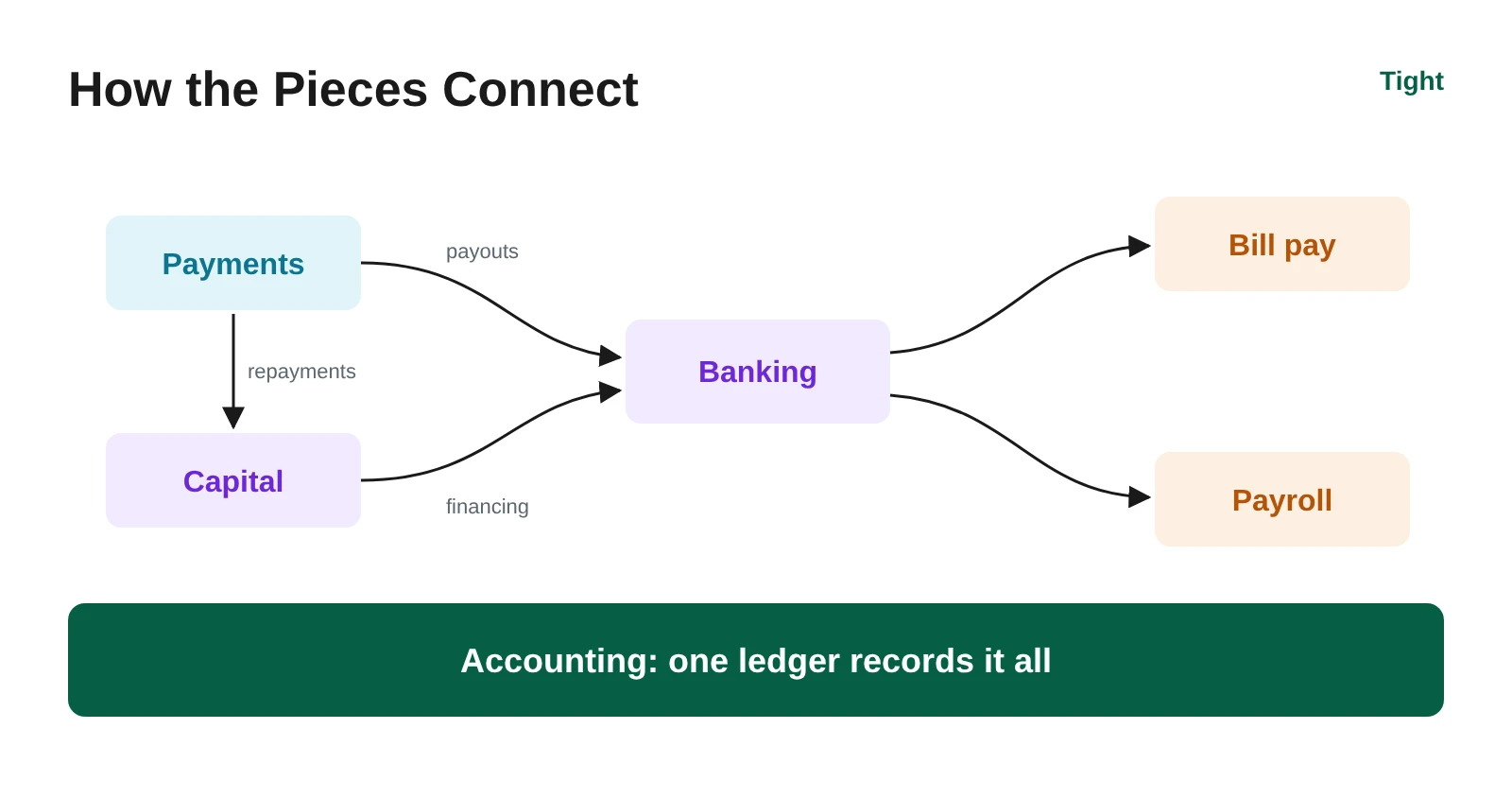
Payments also feed other capabilities directly. Payouts settle into the business’s bank account. Capital providers often base offers on payment history and may collect repayments by withholding a share of future sales. Because one payout can bundle sales, refunds, fees, and those repayments together, payments are often where reconciliation work begins when they aren’t connected to the ledger.
Money Out
Payroll and bill pay send money to employees, vendors, and suppliers. These flows become expenses or pay down something the business already owes. This is where timing matters most, as cash leaves the business on one date but the obligation may have been created days or weeks earlier.
Payroll
Payroll pays employees and contractors from within the platform where the small business already manages its people and schedules. Embedded payroll typically calculates gross-to-net pay, withholds and files payroll taxes, and pays workers by direct deposit. Wages are an expense, while amounts withheld are held as obligations until they’re paid to the right parties. If only the net withdrawal reaches the books, labor costs are understated and those obligations go untracked.
Each run draws on the business’s bank account, but the books need it split several ways: gross wages and employer taxes as expenses, withholdings and any taxes not yet remitted as liabilities, and net pay as the cash that went out. On platforms that already track jobs, shifts, or hours, a connected ledger can also tie labor costs to the work they paid for.
Bill Pay
Bill pay enables businesses to pay vendors and suppliers from inside the platform they already use to run their day-to-day operations. It often covers capturing bills, routing them for approval, and scheduling payment by ACH, check, or card. Depending on the business’s accounting method, a bill may be recorded when it arrives and cleared when it’s paid. Either way, the books need to show what’s owed, what’s been paid, and what’s coming due. When bill pay runs in isolation, owners lose sight of upcoming obligations, and cash that’s already spoken for appears available.
Bill pay and payroll draw on the same bank balance, which is why recording bills as they arrive matters: the cash they’ll claim shows up before it leaves. Not every bill is an expense, either. A purchase of inventory or equipment belongs on the balance sheet, so the ledger needs enough detail from bill pay to tell the difference.
Money In and Money Out
Some capabilities move money in both directions, like a financing offer that brings capital in but also takes repayments out or a bank account that receives deposits but also sends transfers. These flows often touch the balance sheet (what the business owns and owes) rather than the profit and loss statement, and that distinction is easy to get wrong when the data arrives from separate systems.
Capital
Capital offers businesses financing, often based on their sales and platform activity, with repayments sometimes taken automatically as a share of sales. It usually takes the form of loans, lines of credit, or merchant cash advances. Financing proceeds generally aren’t considered revenue. They’re recorded as a liability, an amount the business owes, and each repayment is split between paying down that balance and the cost of financing (exact treatment depends on the product, so businesses should confirm it with their accountant). When capital isn’t connected to the books, financing deposits can be mistaken for sales, and automatic repayments can quietly reduce payouts without a clear record of why.
Capital leans heavily on the rest of the stack. Offers are often based on payment history, funds land in the business’s bank account, and repayments may come straight out of future payouts. A connected ledger can give an offer a fuller view of the business than sales alone, including current cash flow and outstanding invoices, and it records each repayment correctly when it’s netted out of a payout.
Banking
Banking gives businesses accounts to hold balances and move money, often in the same place where they get paid. Embedded banking typically includes business deposit accounts, debit cards, and transfers, delivered through a partner bank. Every bank transaction has to match something else in the books, whether that’s a sale, a bill payment, or a transfer. Transfers between the business’s own accounts move cash without counting as income or expenses. When banking isn’t connected, transfers get counted twice or miscategorized, and balances in the platform stop lining up with the books.
Banking is where the rest of the stack settles. Payouts and financing arrive there, and bill payments and payroll runs draw from it, so the bank balance is the one number every other capability touches. That also makes it where disconnection tends to show first: a balance that doesn’t match the books usually traces back to a flow elsewhere in the stack that was recorded incompletely.
Underneath It All: Accounting
Accounting doesn’t move money in either direction. Instead, it records every flow the other five capabilities create, which is why the map places it beneath them as the foundational layer each one writes to. It maintains the general ledger, a double-entry record in which every transaction is posted to at least two accounts so the books stay in balance, and produces the statements built from it: the P&L, balance sheet, and cash flow statement. To do that well, it needs complete, timely data from the rest of the stack: gross sales and fees, withholdings, bills, and transfers with their details intact, rather than net totals.
Added as just another point solution, accounting ends up importing that data after the fact, which is where gaps and manual cleanup begin.
How the Pieces Work Together
On a product roadmap, each capability looks self-contained, but the money they move overlaps constantly. A capital repayment comes out of a payments payout. That payout lands in a bank account, which then funds bill pay and payroll. A single deposit can carry the results of three capabilities at once, and each piece has to be recorded correctly for the books to balance.
How It Works in Practice
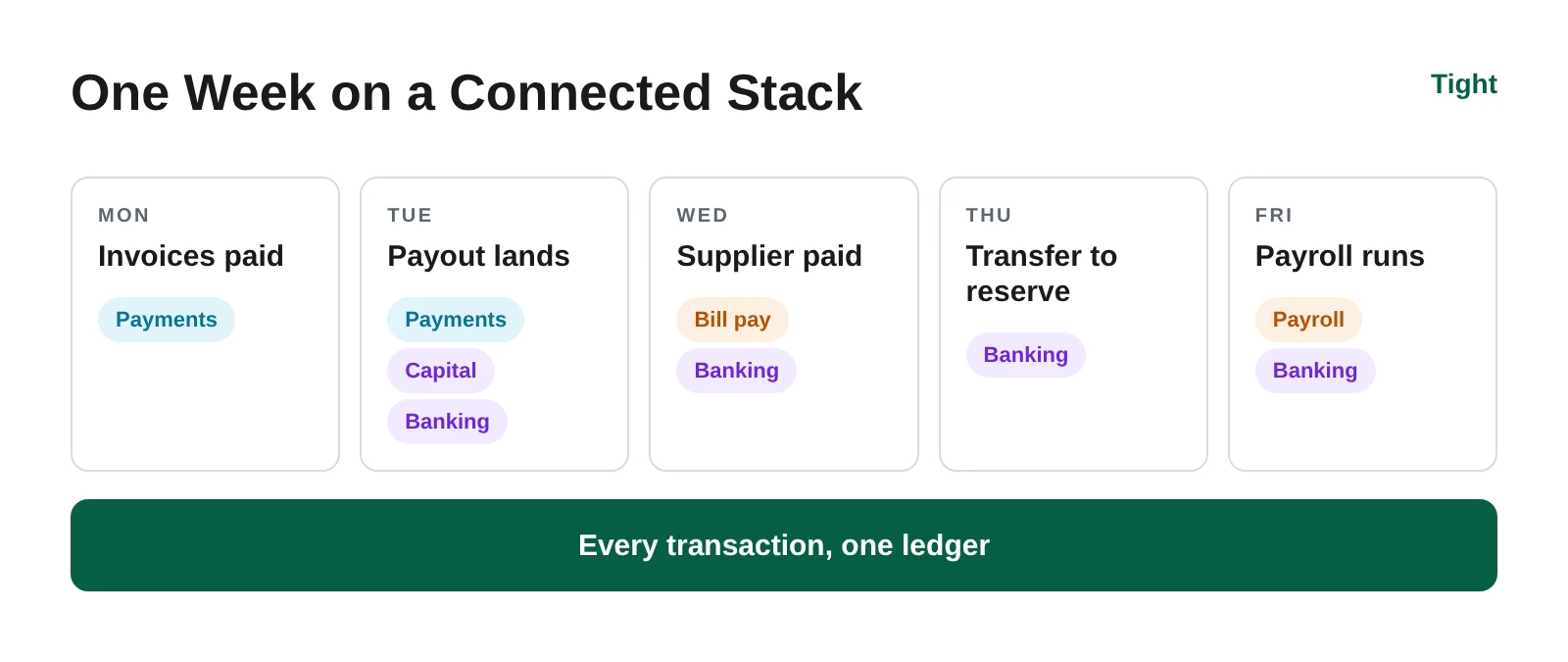
Consider one week at a small landscaping company that runs on a field-service platform with the full stack embedded:
- Monday: Three customers pay their invoices through the platform, and the ledger marks each one paid as the money comes in.
- Tuesday: A payout lands in the company’s account, net of processing fees and a scheduled repayment on a financing offer it took last month. The reconciliation engine ties the deposit back to Monday’s sales, records the fees as an expense, and applies the repayment to the outstanding balance.
- Wednesday: The owner pays a mulch supplier through bill pay, from the same account Tuesday’s payout landed in. The bill that was recorded when it arrived is cleared, and cash goes down by the same amount.
- Thursday: The owner moves money from the operating account to a reserve account. The ledger records it as a transfer between the company’s own accounts.
- Friday: Payroll runs out of the same operating account. Wages are recorded in full as a labor expense, with amounts withheld tracked as obligations until they’re paid.
By Friday afternoon, the business owner can open the platform and see exactly what came in, what went out, what’s still owed, and what’s left, without exporting anything or waiting for anyone to catch up. On a stack of disconnected point solutions, that same week would produce five different records and a reconciliation project to handle at month’s end.
The Ledger Underneath: How an Accounting Foundation Connects the Stack
Mapping out the fintech stack makes one thing clear: accounting is the layer that other financial capabilities write to. When it sits underneath them as a unified foundation, each money flow can feed a single ledger in real time, as transactions occur.
That foundation does four jobs:
- Reconciling transactions: Accurately matching every payout, payment, and transfer to the transaction behind it, down to the granular details
- Unifying the general ledger: Establishing one AI-native record as the single source of truth for every money flow, structured for automation from the start
- Establishing real-time financials: Maintaining current statements that stay accurate as the business runs, instead of trailing the last export
- Providing insights: Building a complete financial view of the business that no single capability could provide on its own
A foundation like this also makes the rest of the stack more useful. Because every capability writes to and reads from the same record, the business owner, their bookkeeper, and any AI assistant inside the platform all work from the same numbers, and the platform can see each customer’s full financial picture instead of six partial ones. That’s what moves a platform from a set of point solutions toward a full financial OS for its customers.
In What Order Should SaaS Platforms Embed Fintech Capabilities?
Payments are usually where platforms start, since they sit closest to the core workflow and bring in money. From there, the next additions tend to follow customer demand, whether that’s payroll, bill pay, capital, or banking.
Accounting often comes last, added as a final box to check once everything else is live. But since every other capability writes to the books, that order leaves each one running in isolation until accounting arrives, with its history to reconcile after the fact. A build order that follows the map avoids that.
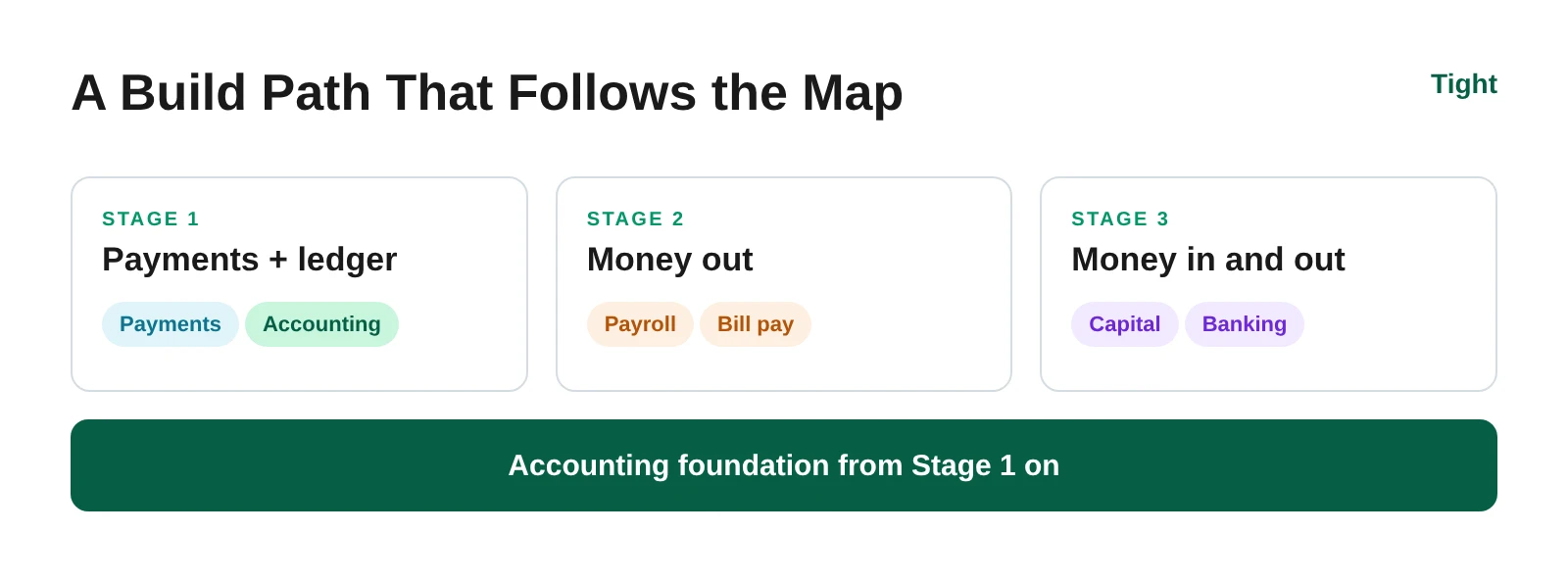
Stage 1: Payments, Then the Ledger
Payments generate the transaction data the rest of the stack builds on, which makes the accounting foundation most valuable right after them. If payments are already live, accounting is the logical next step. Sales, fees, refunds, and payouts get reconciled from the start, and every capability added later has a ledger to write to on launch day.
Stage 2: Money Out
Payroll and bill pay are natural next additions, in whichever order fits a platform’s customers: payroll first for businesses with crews or staff, bill pay first for those managing many suppliers. With the ledger already in place, wages, withholdings, and bills land with their full detail rather than as net withdrawals. For platforms that launched payroll before accounting, accounting is the natural follow-on.
Stage 3: Capital and Banking
Capital and banking deepen the platform’s role in a customer’s finances, and both work best on top of a connected history. Capital draws on the transaction record the earlier stages build, and banking lines up with the books only when every deposit and withdrawal can be matched to the activity behind it. Some platforms launch banking earlier, alongside payouts; either way, it should connect to the ledger from day one.
We make the full case for moving accounting up the roadmap in our post on why accounting shouldn’t be the last embedded feature you add.
Mapping Your SaaS Platform’s Stack
Five questions can serve as checkpoints, showing you where your platform’s money flows end up today and what to build next.
- Can you trace a single payout? Pick a recent payout and try to tie it back to the sales, fees, refunds, and any financing repayments inside it without leaving your product. If you can’t, reconciliation is the first gap to close.
- How many records hold your customers’ finances? List each capability you offer and who provides it. Each separate provider typically keeps its own record of the money it moves. If that adds up to more than one record, plan how each will feed a single ledger before adding anything new.
- Can an owner answer the basics without exporting? Log in as a customer and look for what came in this week, what went out, and what’s still owed. Try it as an owner who does their own books, then as a bookkeeper closing the month. If either one gets stuck, the financials aren’t real-time where it matters.
- Which stage are you in? Match what’s live to the stages above. If you offer money-in or money-out capabilities without a connected ledger underneath, that foundation is your next build, ahead of capital or banking.
- Where will your next capability’s data land? Before adding anything new, decide how it will write to the ledger at launch, so it doesn’t start out as one more record to reconcile.
If several answers point to disconnected records, the next step is a foundation that connects them.
Where Tight Fits in the Stack
Tight is the embedded, AI-native accounting foundation that sits beneath your platform’s fintech stack, connecting each money flow so every transaction lands in the same place—accurately, in real time, and ready for the AI experiences you’re building next.
To learn more, explore our embedded accounting API, or talk to our team to set up a call.
Frequently Asked Questions
What is the embedded fintech stack?
The embedded fintech stack is the set of financial capabilities a software platform builds directly into its product. For SaaS platforms serving small businesses, the six most common are payments, capital, payroll, bill pay, banking, and accounting.
What’s the difference between money-in and money-out capabilities?
Money-in capabilities, like payments, bring funds into a business. Money-out capabilities, like payroll and bill pay, send funds out. Capital and banking work in both directions, while accounting records every flow without moving money itself.
Why does accounting sit underneath other fintech capabilities?
Every money flow eventually has to be recorded in the books, regardless of which capability handles it. A unified accounting layer gives the other capabilities a single ledger to feed, which is what connects them.
What order should SaaS platforms add embedded fintech capabilities in?
A practical order is payments first, then the accounting foundation, then money-out capabilities like payroll and bill pay, followed by capital and banking. Putting accounting in early means every capability added afterward writes to the books from launch instead of being reconciled after the fact.
Do platforms need all six fintech capabilities?
No. Platforms typically add fintech capabilities over time, based on what their customers need. Mapping which flows you offer today, and where each one's data ends up, makes it easier to decide what to add next and how to connect it.

Disclaimer: The information contained in this document is provided for informational purposes only and should not be construed as financial or tax advice. It is not intended to be a substitute for obtaining accounting or other financial advice from an appropriate financial adviser or for the purpose of avoiding U.S. Federal, state or local tax payments and penalties.
Ready to Get Started?
Fill out the form below to set up a call.