From Point Solutions to a Financial OS: The Next Era of Embedded Fintech

Why the next wave of embedded finance is about connecting every money flow
Over the past several years, SaaS platforms serving small businesses have added financial features at a remarkable pace. Payments came first, then capital, followed by payroll, bill pay, banking, and—usually last of all—accounting. Each addition made sense on its own, and each one made the platform more useful to the businesses relying on it.
Most of those features were added the same way: one provider at a time, each with its own dashboard, data, and view of the customer’s money. The end result is a stack of individual point solutions, with no centralized “glue” holding them together.
That approach is how embedded fintech got off the ground, but it’s now reaching its limits. As SMB SaaS platforms compete to become the place their customers run their entire business—a one-stop operating system—what matters most is whether every dollar moving through the platform connects in one place. Ideally, that connection starts with the books.
Below, we trace how embedded fintech got here, why point solutions are running out of road, and what it looks like when a single platform becomes the complete financial OS for its small business customers.
How Embedded Fintech Was Built: One Feature at a Time
Before embedded fintech, most platforms handled their small business customers’ financial data by sending it somewhere else. That data left the platform as an export, usually a CSV of transactions or invoices, and the business owner (or their bookkeeper) re-entered it into separate accounting software like QuickBooks or Xero.
Embedded fintech changed that by bringing financial services directly into the platform itself. But it arrived as a series of discrete capabilities, added in a familiar order:
Each new capability came from its own separate provider, and many platforms treated the roadmap as a checklist: add one feature, check the box, and move on to the next. This was a fast way to ship features, but it left platforms with a stack of tools that work in isolation.
For a deeper look at each type of embedded finance, check out our comprehensive guide with real-world examples. And for a capability-by-capability map of how the pieces connect, see The Embedded Fintech Stack, Mapped →
The Problem With Point Solutions: Nothing Connects Them
Point solutions are good at carrying out their one job. The trouble tends to pop up in the spaces between them.
When core tasks like payments, payroll, bill pay, and banking each run through a separate provider, each one keeps its own record of the customer’s money, and nothing ties those records together. That means a single business might have its revenue in one system, its payroll history in another, and its vendor payments in a third. Each system holds pieces of the financial picture, but never the whole thing at once.
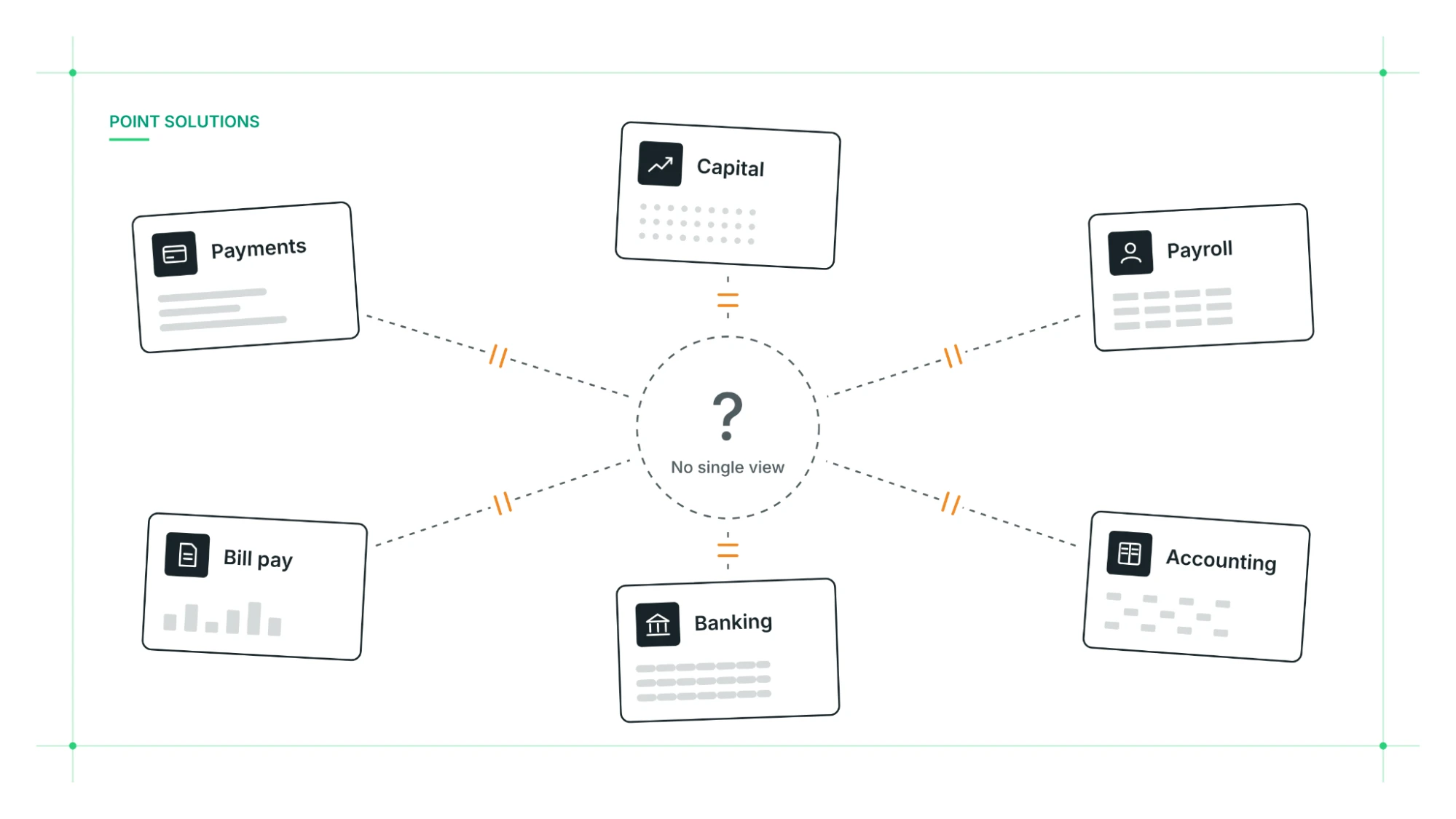
That gap typically shows up in four ways:
Fragmented Data
Every provider defines and stores transactions its own way. Combining them into a single view is a manual process involving custom engineering work, and that work has to be revisited and maintained every time a provider changes something in its system.
Reconciliation Falls to the Business Owner
When systems don’t talk to each other, someone has to make the numbers line up. That job usually lands on the busy business owner or their bookkeeper, and it’s exactly the kind of grunt work embedded fintech was supposed to eliminate in the first place.
An Incomplete Picture of the Business
Without one connected record, neither the business owner nor the SaaS platform can address critical financial needs with confidence. That includes answering basic operating questions like: How much did we make this month? Can we cover payroll and still pay our suppliers? Is there room in the budget for a new hire?
Every New Feature Adds Another Silo
Each new point solution makes the problem worse by introducing one more data set that doesn’t connect to the others. The more capabilities a SaaS platform adds this way, the more fragmented its SMB customers’ finances become.
Why Accounting Belongs at the Foundation
If you look at the six core financial capabilities side by side, one stands apart. Payments handle money coming in; payroll and bill pay handle money going out; and capital and banking move money in both directions. Accounting is the only layer that records and reconciles all of it.
Every money flow, no matter which provider handles it, eventually lands in the books. That makes accounting the natural place to connect everything else. When the accounting layer sits underneath the other capabilities, each one feeds a single ledger instead of keeping its own isolated record.
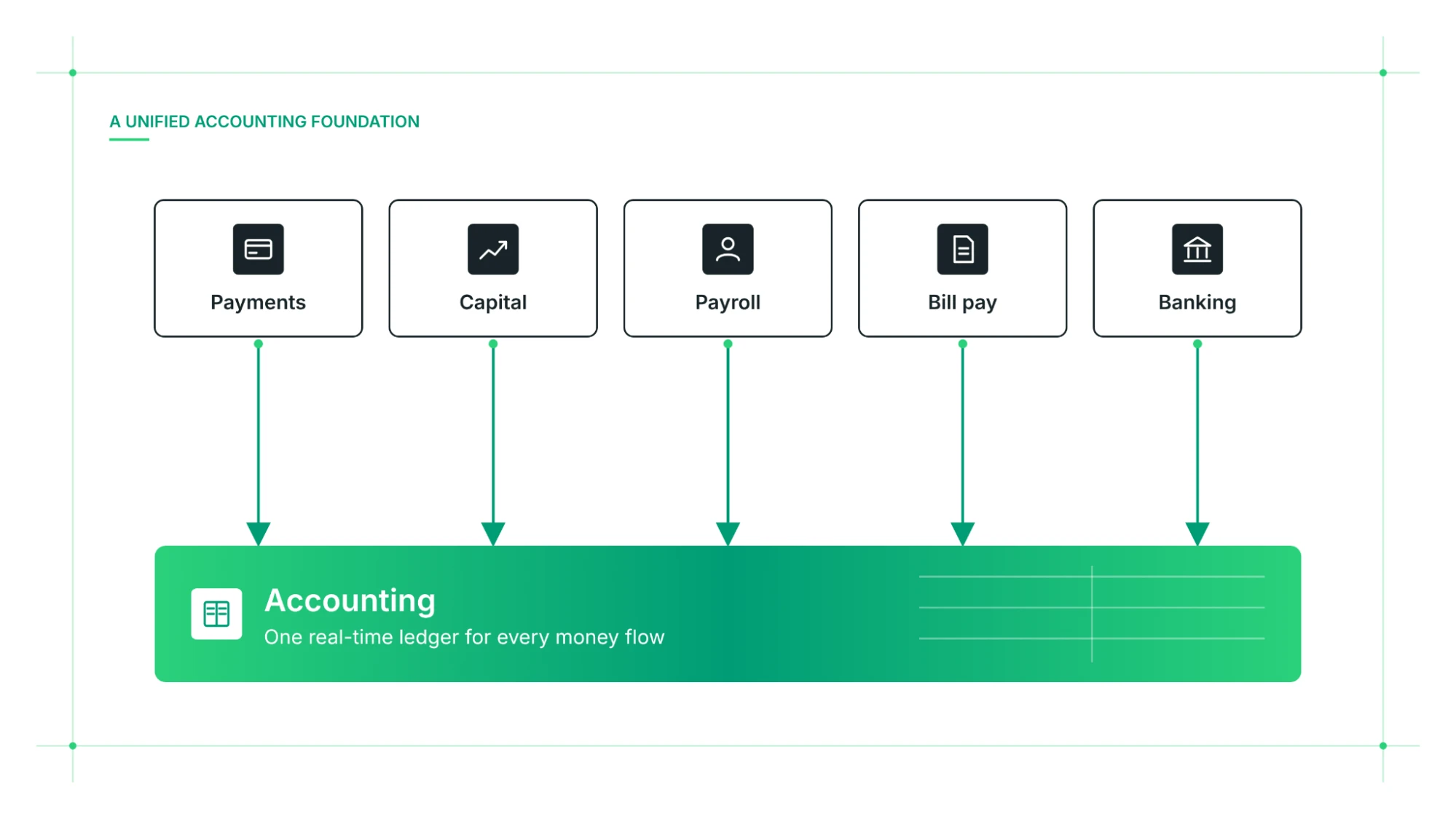
In practice, a unified accounting foundation brings together four things:
- A reconciliation engine that matches every transaction across all money flows, down to the granular details
- A unified general ledger with consistently structured data, so it’s AI- and automation-ready from the start
- Real-time financials that stay accurate as the business runs, instead of trailing the last export
- Holistic insights drawn from a full financial picture of the business
This also reshapes the roadmap. Platforms have historically added accounting last, after everything else was already in place. But because every other feature depends on it, building the foundation first makes every feature added later more connected and more useful from day one.
What It Means to Become Your Customers’ Financial OS
When every money flow connects through one foundation, a SaaS platform’s role expands. Instead of hosting one piece of an SMB owner’s finances, it becomes the go-to place where they run the entire financial side of their business.
Here’s what a complete financial OS looks like for the businesses using it:
- Money in and money out in a unified view: Revenue, payroll, vendor payments, and balances show up together in real time.
- Books that keep themselves current: Transactions are categorized and reconciled as they happen, so everything is up to date and there’s no month-end scramble.
- Decisions made in context: Business owners can see whether they can cover payroll or afford a new hire this month inside the same product where they run their operations.
- Support for every kind of owner: It works for business owners who handle their own books, as well as those who work with an outside bookkeeper.
For the SaaS platform, the payoffs add up over time, including deeper customer engagement, stronger retention, and a product that’s much harder for customers to replace.
Where Embedded Fintech Is Headed
The first wave of embedded fintech was about access, getting financial services inside software at all. The second wave, the point-solution era, was about breadth, adding as many capabilities as possible. The next era will be about connection.
That shift matters even more as AI enters the picture. An AI assistant or agent working inside a SaaS platform can only act on the financial data it can reach, and fragmented data spread across separate systems and providers is hard for any model to act on. A unified, real-time ledger, exposed through tools that agents can use, gives AI something more reliable to work from. That’s why we see the business owner’s AI assistant as your platform’s likely next user.
This is what we call automation with certainty. AI can take on the grunt work because it’s working from real-time books that are both accurate and complete.
SaaS platforms that build on a connected foundation will be ready to offer that kind of experience to their small business users. Those still stitching together point solutions will spend more and more of their time matching up numbers to keep the seams from coming apart.
Where Tight Comes In
Tight provides the embedded, AI-native accounting foundation that connects a platform’s money flows. It brings the general ledger, reconciliation engine, real-time financials, and insights together in one layer, which sits beneath the payments, payroll, banking, and other features a platform offers. That way, every transaction lands in the same place. Through Tight’s MCP server, that same foundation is ready for the AI experiences that platforms are building next. And because it’s fully white-labeled, the financial OS your SMB customers use carries your branding from end to end.
To learn more about Tight’s embedded accounting solution, reach out to our team—or explore our accounting API to see it in action.
Frequently Asked Questions About Embedded Fintech
What is a point solution in embedded fintech?
A point solution is a financial capability, like payments or payroll, that does a single job. It’s typically added to a SaaS platform as a one-off through an outside provider. Most platforms currently build their embedded fintech offering one point solution at a time, which leaves each capability with its own separate data.
What does it mean for a SaaS platform to be a financial OS?
A SaaS platform becomes its customers' go-to financial operating system (OS) when it's the central place where they move and manage money. That includes tasks like getting paid, paying employees and vendors, holding balances, and keeping the books, all connected in real time.
Why is accounting the foundation of embedded fintech?
Every money-in and money-out flow eventually lands in a small business’s books. A unified accounting layer gives every other capability a single, real-time ledger to feed, which is what connects them.
Do SaaS platforms have to replace their existing fintech solutions and providers to connect them?
No. A unified accounting foundation is designed to sit underneath the providers a platform already uses, connecting their data rather than replacing them outright.
Is embedded accounting the same as embedded bookkeeping?
No. Embedded bookkeeping refers to a white-labeled service where human bookkeepers manage the books on a SaaS platform's behalf. Embedded accounting is software infrastructure, where the ledger, reconciliation, and financials live inside the platform and update automatically, whether a business owner does their own books or works with a bookkeeper. To go deeper into the difference between them, check out our definitive guide to embedded accounting.

Disclaimer: The information contained in this document is provided for informational purposes only and should not be construed as financial or tax advice. It is not intended to be a substitute for obtaining accounting or other financial advice from an appropriate financial adviser or for the purpose of avoiding U.S. Federal, state or local tax payments and penalties.
Ready to Get Started?
Fill out the form below to set up a call.